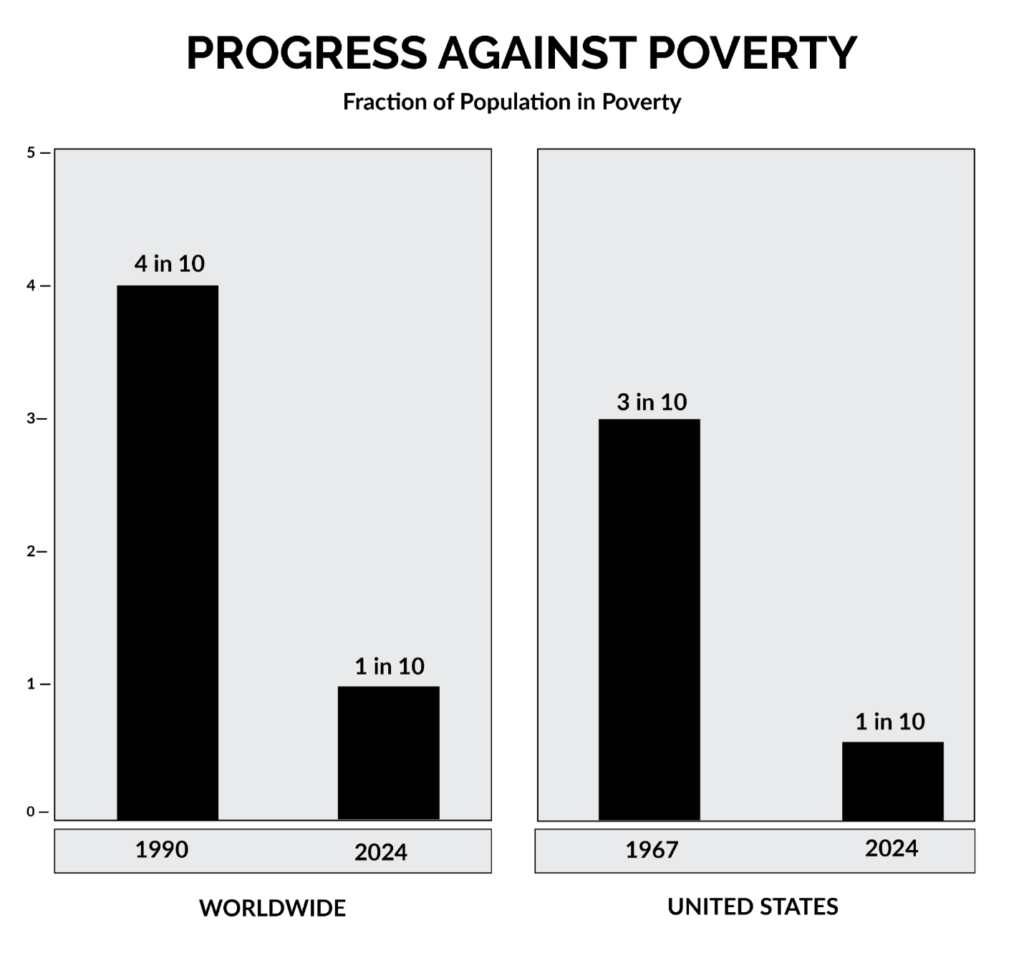
Our country and the world have many problems, but poverty is a fixable problem. Dramatic progress in reducing poverty has been made in recent decades, with the fraction of the world’s population living in extreme poverty dropping from around four in 10 people in 1990 to one in 10 in 2024. The fraction of Americans living below the US poverty line has dropped from three in 10 in 1967 to around one in 10 in 2024. I see this great liberation as an exodus – an experience of our loving God in our time.
Our government played an important role in reducing poverty in both the US and globally. Active citizens – including hundreds of thousands of church people – helped to make it happen.
But progress against hunger and poverty is now grinding to a halt, mainly because of policies of the current administration. They include deep cuts in health and food assistance and the elimination of much of our nation’s program of international assistance. Mass deportation, attacks on civil rights and voting rights, the elimination of government efforts to moderate climate change, tariffs, and war are also making many more people poor.
My new book, Poverty Abolitionists: Faith, Activism, and Hope for Difficult Times, discusses 10 effective ways to push back and get progress against poverty going again. I have spent decades focused on faith-based legislative advocacy, always working in a bipartisan way. But while legislative advocacy is still important, it is not enough,
Elections
One of the 10 strategies I highlight in my book is activism in elections. Since this magazine is being published just after the midterm elections, I’ll focus first on how important engaging with elections is.
Nearly all churches refrain from endorsing candidates and parties, partly to avoid dividing their people and partly to qualify for tax-deductible contributions. Yet Christian people in a democracy are, in my view, called by God to be active in elections.
That includes voting. Many people find it helpful to make a plan to vote and note when they will vote on their calendars. You might also make a list of other people you intend to encourage to vote. You could offer to drive an elderly neighbor to the polls.
You can also volunteer to help a candidate. According to one survey, only 4% of Americans volunteer for campaigns or parties. But political campaigns need people to make calls, write postcards, staff tables at farmers markets, and knock on doors. Call a campaign you support and ask how you can help.
Conversations about elections with family and friends are important. In my experience, respectful listening is often the most influential part of conversations about politics.
My most controversial recommendation is about giving money to candidates and political parties. According to Federal Election Commission data, only 2% of Americans give more than $100 a year to influence the outcome of elections. So, we leave it to a relatively small group of mostly wealthy people to finance the process by which we choose our government leaders.
Churches in the run-up to elections
In the run-up to elections, churches and clergy can do more than we usually do to discuss moral and religious issues in politics – without dividing our churches or risking their tax-exempt status. We can and should:
- Preach and teach about the values and beliefs at stake in the nation’s political debate;
- Encourage people to be active – and generous – in shaping elections, explaining that contributions to candidates are an aspect of good stewardship;
- Participate in efforts to encourage and protect voting, especially among people of color and low-income people; and
- Organize opportunities for people to discuss election issues in a civil way.
Presiding Bishop Sean Rowe speaks clearly about what The Episcopal Church can do, and what it might need to do, to oppose authoritarianism and Christian nationalism.
Virginia Theological Seminary (VTS) responded to Bishop Mariann Budde’s sermon at the National Cathedral’s presidential inauguration service by developing an array of resources on the theme Have Mercy, including the publication of a book of essays by faculty from VTS and The General Theological Seminary Have Mercy: Following Jesus in Politically Perilous Times.
Moses, Samuel, and Jesus all addressed political leaders and spoke about political issues. I pray that religious leaders across the country will speak out at this critical time in our nation’s life.
Other strategies to reduce poverty, including reforms in religion
Poverty Abolitionists also includes chapters on community organizing, charities, and business. It talks about ways to make information technology helpful rather than harmful, with a focus on how information technology affects low-income people. My book also urges effort to connect across the bitter divide between conservative and progressive people. We will not be able to restore progress against poverty or successfully address the other big problems our nation faces unless conservative and progressive people can work together.
My last three chapters discuss data-informed reforms in American religion and spirituality that could make our country more committed to social justice. First, survey data and sociological studies demonstrate the benefits of going to church. Notably, a Pew Research Center international survey in 2019 found that people who are part of a religious community tend to be happier, more charitable, and more active in civic affairs. But some strains of religion have long been obstacles to social justice. Most white Christians voted for Donald Trump in 2016, 2020, and 2024. So, I urge my readers to seek out a loving, social-justice oriented religious community.
The second chapter about religion is grounded in a years-long Baylor University study on how Americans experience God (see America’s Four Gods by Paul Froese and Christoper Bader, Oxford University Press). When Froese spoke to a seminar I taught at Union Theological Seminary in New York, he presented data on the relationship between how people experience God and their support for economic justice policies.
One clear pattern in the data surprised me. People who experience God as remote or nonexistent tend to be more supportive of economic justice than people who believe that God intervenes actively – often miraculously – in human affairs. In fact, atheists are generally more supportive of economic justice policies than the 90 percent of Americans who believe in God or think there might be a God.
Among religious people, those whose faith includes an element of doubt are more likely to be supportive of economic justice. The link is education. People who have had the benefit of education are more likely to be scientifically minded. They are more likely to understand how public policy can make the world better.
These connections between education and social change are one reason to defend schools and universities. It is also a reason to support religious education – an educated clergy and church-based education that includes learning about the Big Bang, community problems, and political issues
My third chapter on spirituality is my favorite part of the book. The Baylor studies also found that half of the Americans who believe in God (or think there might be a God) experience God as more judgmental than forgiving. Those of us who experience God as more forgiving than judgmental are more likely to support economic justice. So, it turns out that sharing the Gospel of God’s forgiving love in our families and churches is a powerful way to make our country more generous and committed to policies that can reduce – maybe virtually end – hunger and poverty.
I have addressed Poverty Abolitionists to people of all faiths and no faith. But I am a Chrisian pastor and end the book with a confession of my faith in God as revealed in the biblical exodus and the resurrection of Jesus Christ. God’s embrace is my motivation for ongoing efforts to abolish poverty.
You can purchase Poverty Abolitionists: Faith, Activism, and Hope for Difficult Times here.
The views expressed in this article are those of the author and do not represent the views of Virginia Theological Seminary.
The Rev. Dr. David Beckmann is a pastor, economist, and activist. At his ordination as a Lutheran pastor, he was called to be a “missionary-economist.” Early in his career, he worked among people in poverty in Ghana and Bangladesh, then for 15 years at the World Bank. He devoted the last three decades of his career to leadership of Bread for the World, an ecumenical advocacy network that urges Congress to do its part to end hunger. He was awarded the World Food Prize in recognition of Bread for the World’s contribution to progress against hunger in Africa. He is now Coordinator of the Circle of Protection, an advocacy coalition of church bodies and Christian organizations that includes The Episcopal Church.