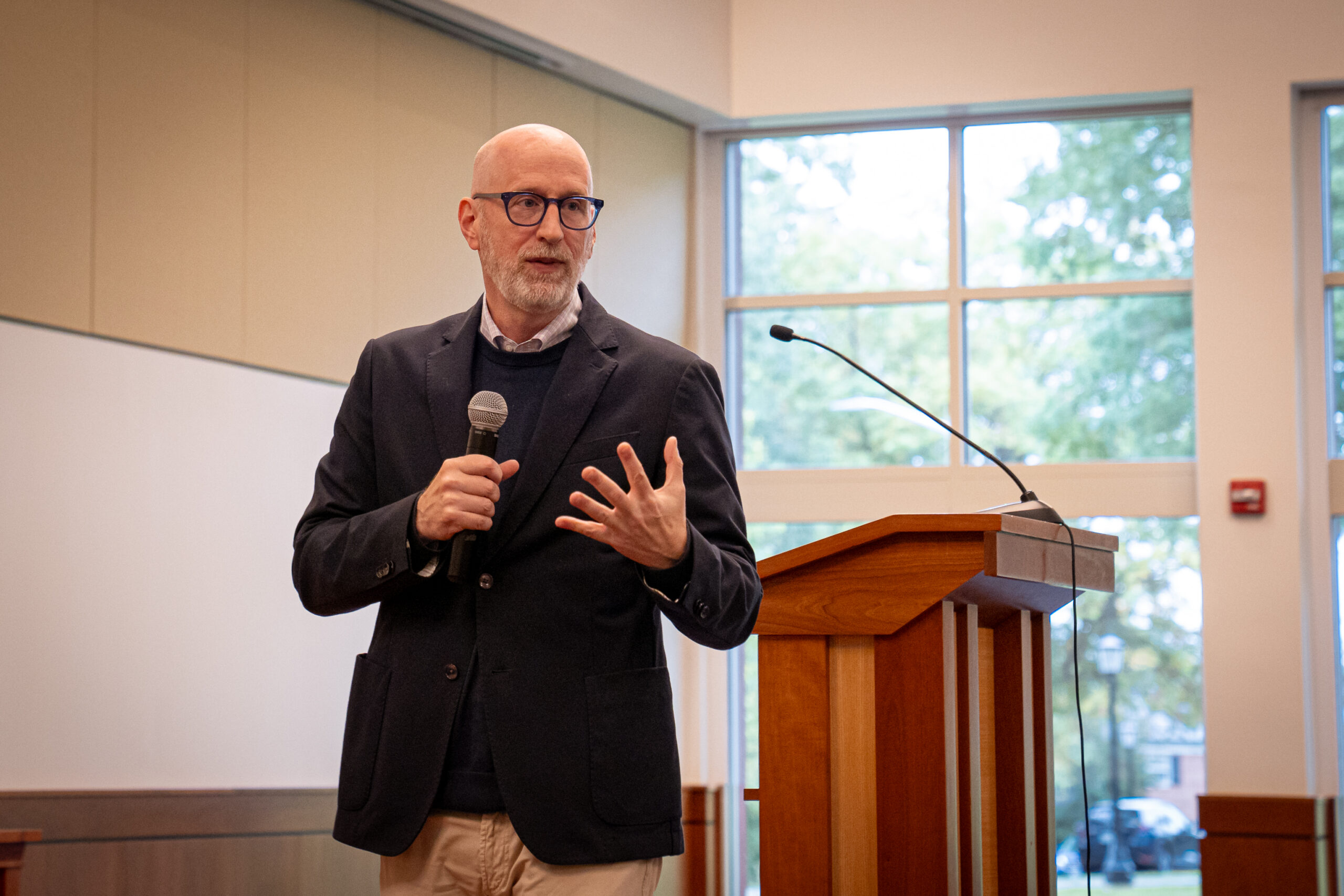
There is a way back from the antagonism and division currently rending America, but it’s going to require courage and love, according to New York Times columnist and constitutional scholar David French. Even then, there is no guarantee it will succeed, he warned.
Acknowledging that the country was in a “moment of deep political misery,” French, a Harvard-educated lawyer, political commentator and fellow at the National Review Institute, said he was not sure how much damage would be done to the nation before the trends of antagonism could be stopped.
“Americans need to be less optimistic that we’re just going to get through this, and more alarmed that that just doesn’t happen naturally,” he said. “The bottom line is if we’re going to get through this – and I think we will, I don’t know we will, I think we will – but [that] depends on moral courage, it depends on people taking risks. It depends on people loving their neighbor. And if we can’t do that, we will be lost.”
French added that he is pessimistic in the short term but has long-range hope. “I’m long-term optimistic because I believe in God, and God is a God of justice and love,” he said.
Speaking at Virginia Theological Seminary’s Convocation in October 2025, French observed that a crucial aspect of the current American story was the “centrality of hatred. This animosity has been “boiling” for some time, French said, citing a 2014 Pew Research Center finding that roughly 80 percent of respondents from both the Republican and the Democratic parties reported they somewhat or strongly disliked the opposite party.
“Already, the dominant characteristic of American politics was something called negative polarization,” he explained. In other words, people were aligning with a party, or faction, more out of hatred for or fear of the opposing side than because of shared values. The problem with negative polarization is by its very nature, it’s just constantly pitting you against your neighbor,” said French. “It’s a constant process of opposition.”
The traditional elements of Reagan conservatism – limited government, a strong national defense emphasizing international alliances and social conservatism – are counter to what Trump represents, he said. “You’re looking at a situation where in many ways the Republican Party had departed from conservatism, but without fracturing its core base and core identity,” said French. “Why? Because the core base and the core identity moved to anti-left. So, ‘Whatever the left is for, I’m against.’”
A similar process could be seen taking place within the Democratic Party, he said. “When you are adopting a position that is fundamentally oppositional, then conflict, rather than compromise, becomes the salient characteristic of political engagement. It’s all about conflict. Right now, we’re in a position of utter, utter anger in American life between partisans. This anger is overwhelming.”
That division has become much worse in the years since the 2014 study, according to French, who described three phenomena that have propelled the U.S. to where it is today politically. The first of these is what he referred to as “the big sort,” a term from Bill Bishop’s book, The Big Sort: Why the Clustering of Like-Minded America is Tearing Us Apart.
Whereas in past decades, Americans relocated for jobs or military postings, “now we have ideological migrants, people who will move to a place where they feel more comfortable politically,” French explained. This phenomenon has led to a new record for the percentage of voters who live in a landslide county – defined as being one where a candidate in a presidential race wins by 20 or more points – being set about every four years.
“But there’s something else that happens to us when we get in a community of like minds,” French said. “The law of deep polarization says that when people of like mind gather, they tend to become more extreme.” When we are surrounded by people who agree with us and don’t raise any objections, we double down, becoming even more extreme, he explained.
“It’s called a cascade. They don’t even know that they’re becoming more extreme because they’re mainstream in their community.” In previous eras, candidates would run to one side for a primary and then the middle for a general election, French said. That is happening less now.
“Politics has become less a matter of persuasion and more a matter of mobilization – how big is my tribe and how much of my tribe can I get to the polls, as opposed to how much can I grow my tribe, through reason, persuasion, etc. The very act of persuasion is seen as weakness.”
Alongside the big sort and the law of polarization, the third phenomenon is what French terms “nutpicking.”“A lot of our hatred and anger for each other is rooted in an endless stream of communication that reinforces how bad the opposition is,” he explained. “Nutpicking is when people on social media or elsewhere will find an extreme version of the other side – maybe the worst version of the other side – and put them out and say, ‘That’s what they’re all like.’”
This practice was seen following the assassination of Charlie Kirk. All evidence suggested it was the work of one person, but it led to rhetoric such as “‘They’ tried to assassinate Trump, ‘they’ killed Charlie Kirk,” French said. “You begin to take the worst elements of the other side and you advance them as emblematic,” he said. “What’s the end result of this? Not only do we hate each other, but we’re literally wrong about each other. The more media you consume, the more wrong you are about your opponents. Why would that be? Well, because we’re siloing ourselves into partisan media.”
Rather than acting as a firewall against the big sort, group polarization and nutpicking, religion has instead enabled them, French warned. He said it was “one of the great tragedies of the moment” that the Christian community was not setting a countercultural example of love, and of the fruits of the spirit of kindness, peace, patience, gentleness and self-control. Instead, many Christian leaders had tied the fate of the Church and of the U.S. to their political power.
“What we are seeing right now is a situation in which countless Americans are saying, ‘My religious point of view is under such threat and my dependence on politics is so great that to address that threat, the ends will justify the means,’” French said.
“And those means that we are choosing are ripping this nation to shreds, ripping families to shreds, ripping friendships to shreds, ripping it all to shreds because the moment and the time and the era is just too important for weak values like kindness, weak values like gentleness. Now is the time of the fighter and that message is ripping us apart as a country.”
But he said there were examples Christians could follow if they wanted to heal the divisions in this country, such as Jesus himself and leaders of the American Civil Rights Movement. French, along with his friends, Russell Moore, former head of the Southern Baptist Convention’s Ethics and Religious Liberty Commission, and Curtis Chang, former executive and pastor with InterVarsity, has developed a curriculum called “The After Party: Towards Better Christian Politics” centered around Micah 6:8: “What does the Lord require of you, O man? What is good?”
French pointed out that the Lord requires us to act justly, to love kindness and to walk humbly before him, but most Christian political engagement, particularly within the white evangelical tradition, is not living up to those requirements. “Both the example of Jesus and the example of the Civil Rights Movement completely rebuke the political culture of American activist, Trumpist Christianity,” he said.
He added that the New Testament was written at a time when Christians were facing persecution that we cannot fathom. “And the answer was love your enemies. And for us to act as if we’re now in a place where all the New Testament doesn’t matter… because we’re in an urgent political moment [is] completely false.”
A guiding principle of the Civil Rights Movement was nonviolence and mercy even in the face of violence against activists, French said. The Rev. Dr. Martin Luther King Jr. was so committed to nonviolence that protest pledge cards listed the characteristics he sought in those marching, including “we seek justice and reconciliation, not victory.”
Loneliness and feeling alienated are partly driving the extremism of today, but there is a powerful antidote, French said. “I think one of the most concrete things that we can do to heal this country is to love a person who’s different from ourselves, to enter into relationships and friendships with people who are different from ourselves. This is a tonic to our national soul if we can execute this.”
You can watch David French’s lecture here: