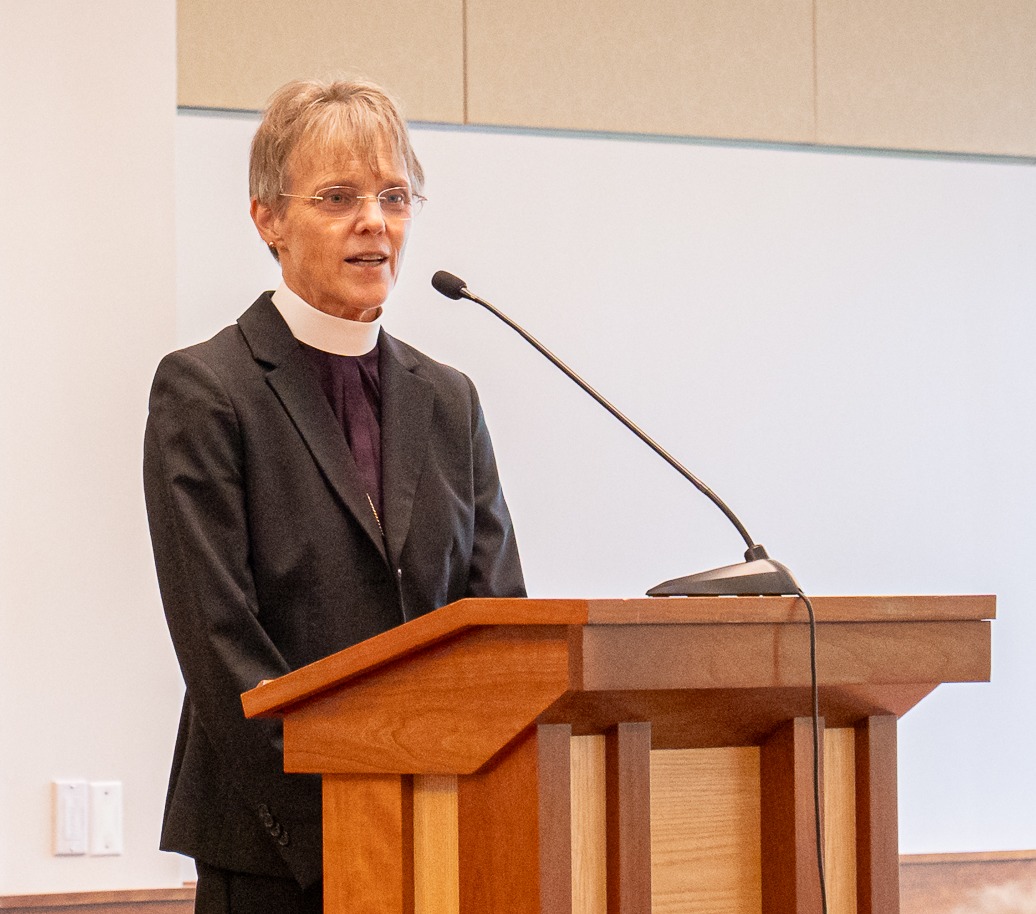
The response to the sermon preached by the Right Reverend Mariann E. Budde, ninth bishop of Washington, at the Service of Prayer for the Nation at Washington National Cathedral, was swift and “overwhelmingly negative.”
“In those first days, we were overrun with messages of visceral condemnation,” she recalled. “It’s like a huge ocean wave that just washes over you and knocks you to the sand and then twirls you around, and there’s nothing you can do.”
This onslaught of condemnation was triggered by Bishop Budde’s now famous appeal to President Donald Trump to have mercy on those who were scared, such as members of the LGBTQ community, refugees fleeing war and persecution, and undocumented immigrants, the vast majority of whom, she pointed out, were not criminals, but rather “good neighbors.”
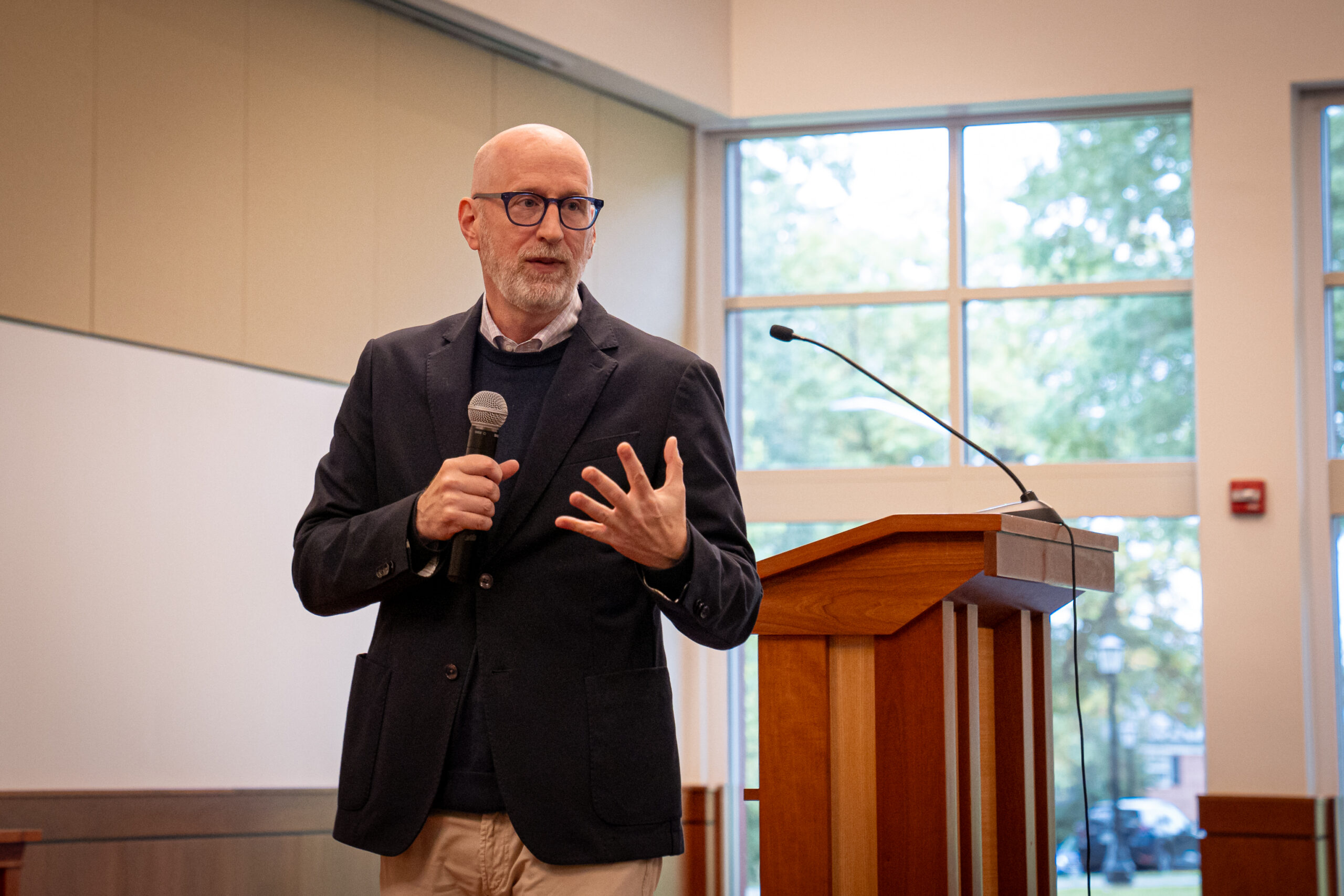
During this turbulent time, Bishop Budde remembers seeing Virginia Theological Seminary’s public statement of institutional support for her.
In a social media post which went viral, the Very Rev. Ian S. Markham said: “We are proud of our alumna Bishop Mariann Budde for her faithfulness to the Biblical witness. To ask a President to be merciful is in the tradition of the prophets of the Hebrew Bible. While the overwhelming response VTS has received about her sermon has been positive, we have also received various complaints about our work because of her training in our Master of Divinity and Doctor of Ministry programs. To be clear, we teach the Gospel as reflected in Holy Scripture. We support and stand alongside our Bishop alumna.”
Bishop Budde said she immediately felt she was standing on firmer ground. She explained that the Dean’s statement made it so clear that her words were based in biblical truth, and when she was called on to apologize for her remarks, she felt greater calm while saying no. “I cannot apologize for proclaiming the Gospel,” she said. “In times of societal chaos, institutional courage is important because courage is communal, as is our faith.”
Delivering a lecture titled “Courage is Contagious” at VTS’s Convocation in 2025, she said she had accepted Dean Markham’s invitation to speak partly out of gratitude to him and VTS, but mostly to assure her fellow clergy members that their ministry was impactful: “Your words, your witness, your daily efforts to strengthen and sustain a Christian community that embodies a generous orthodoxy and a compelling witness to Jesus’s way of love,” she said.
“Everything I say to you today is in service to the simple idea that courage is contagious, which is to say, like every gift of the Holy Spirit, it’s mysterious and it’s communal. We are inspired to do what feels impossible when we see or hear someone else being brave.
“Courage is also an innate God-given attribute of our species, enabling us to take smaller brave steps, like a child first learning to walk and, sometimes, enormous leaps for the good of humankind.”
Bishop Budde, who earned her Master of Divinity from VTS in 1989, followed by a Doctor of Ministry in 2008, and was awarded a Doctor of Divinity, honoris causa in 2012, shared how VTS had repeatedly given her courage over the years, starting with her earliest days as a seminarian.
She remembered that during her first semester at VTS in 1984, while she was attending morning chapel and introductory classes in biblical studies, the colleagues she had worked with in Arizonia for two years were on trial for providing sanctuary to refugees who had crossed the border illegally. She thought her call to ministry meant she had to give up this work. “It felt like I had cut off a limb, and initially I was miserable here,” she remembered.
But then she learned about a previous seminarian who had taken a year off from her studies at VTS to do mission work in Honduras. Bishop Budde went on to do the same thing, spending a year in Honduras working with children who were living in deep poverty.
“I felt like God was saying to me that my past and present were not as disconnected as I had imagined they would be, and it felt like a horizon I could keep in my sight during those incredibly disorienting first months,” she said. “Her example opened a door for me that I didn’t know was there. So, I ask you, who’s opened a door like that for you, and for whom is your very presence opening a door now for someone else? Courage is contagious.”
Another time in her early days as a seminarian, she remembered how her personal wounds that she had previously successfully kept at bay, hit her with full force. “I tried to put up a good front, but inside I was drowning.”
VTS had invited the academic and psychoanalyst Dr. Ann Belford Ulanov to speak at the Seminary. “Her presence was electrifying, an icon of inner strength and wisdom that pierced my heart. And her words, the recordings of which I listened to dozens of times, gave me courage to face my pain,” she said.
“She helped me name a truth that I had suspected but also did not know what to do with, which was the fact that no matter how noble the causes were to which I dedicated my life, if I didn’t tend to the wounds and the inner contradictions and the sins of my life, I would, through immaturity and arrogance, risk contributing to the very problems I wanted to help solve. And the chasm between the person I wanted to be and the person I knew myself to be felt enormous.”
Bishop Budde explained that when she first dared to give voice to this “rather terrifying truth” to the Rev. Churchill Gibson, who was VTS chaplain at the time, he smiled and told her she was going to love what was waiting for her on the other side of the journey she was about to begin.
“His faith in God’s grace and in my ability to actually walk that journey felt like a light shining on a very dark path that gave me confidence to take a few first steps,” she said.
Quoting Swedish novelist Fredrik Backman, Bishop Budde said: “The world is full of miracles, but none greater than how far a young person can be carried by someone else’s belief in them.”
She added: “Courage is contagious, but so is faith… Who were the people who believed in you when you didn’t believe in yourself? Who are you believing in, investing in now?”
Bishop Budde said she had often been asked what she was thinking prior to preaching her sermon to President Trump. She explained that in the lead up to the service, she had been “shopping” her sermon around among a few people, including a woman leader who worked in public policy, who told her she “didn’t have to go there.”
“But there were a number of people in my world that were really waiting for me to speak,” she said. “Sometimes you speak to the people and sometimes you speak for them.”
She pointed out that the day before her sermon, President Trump had leaned further into his division of people. “The rhetoric against the LGBTQ community, the rhetoric against immigrants and migrants was even worse. He didn’t stop, and I just thought I can’t not go there.”
As she was preparing her sermon, she read about a group of Roman Catholic bishops in California who had strongly and bravely stood up in support of migrants in their communities. She said their courage to speak the truth – that the vast majority of immigrants and refugees are not dangerous criminals, but rather contributing members of society – inspired her to do the same.
But it was not easy. “As I was sitting on the platform, as we were going through all the prayers and the readings and the songs, I was praying two things. Please, Lord, I don’t want to throw up on the podium,” Bishop Budde said.
She added that the day before, somebody had reminded her of a prayer in 12 Step Spirituality for when you are dealing with emotions you do not want to be feeling, and you ask God to replace those feelings with feelings that would be pleasing to God.
“So, I just kept on praying that prayer because I was trying really hard to stay in the moment. But that’s where the struggle was,” she said.
Bishop Budde said the response to her sermon demonstrated that the way the Church applied the Gospel had been for many outside the church like “water in the desert for parched souls.” She added that she saw her role, in part, as strengthening and amplifying the courageous Christian witness that was taking place all over the country.
“We have who we are and our understanding of what it means to follow Jesus in our time,” she said. “Our vocation now is to testify, to speak to what we’ve seen and to live as best we can, imperfectly, according to the highest aspirations of humankind that have been revealed to us in Christ, and the riches of our spiritual heritage. And as St. Paul reminds us, we do not proclaim ourselves. We proclaim Jesus Christ as Lord and ourselves as the world’s servants for his sake.”
Referencing John 12:27-28, when Jesus prays: “Now my soul is troubled. And what shall I say? Father, spare me from this hour? No, it is for this reason that I have come to this hour. Father, glorify Your name,” Bishop Budde said if we pray that prayer along with Jesus, we are in essence saying to God that we are here, we are not going anywhere, and we will do our best to embody the spirit.
“So, it is in that faith that we go on. Our greatest contribution to the world is, by God’s grace, to try to be who we are. The courage that we need will flow through and among us. It is contagious. It is mysterious. It is communal, as is our faith in the abiding, empowering presence of Christ.”