Listening with the Communion of Saints-1

Listening with the Communion of Saints: The Saint Nicholas Center for Faith and Justice

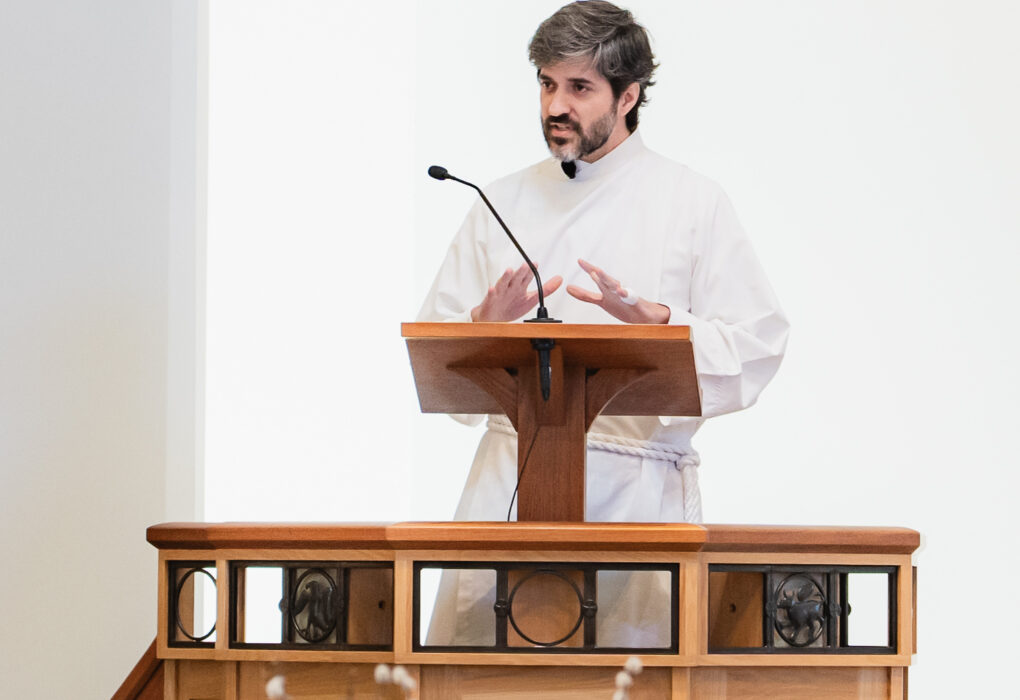
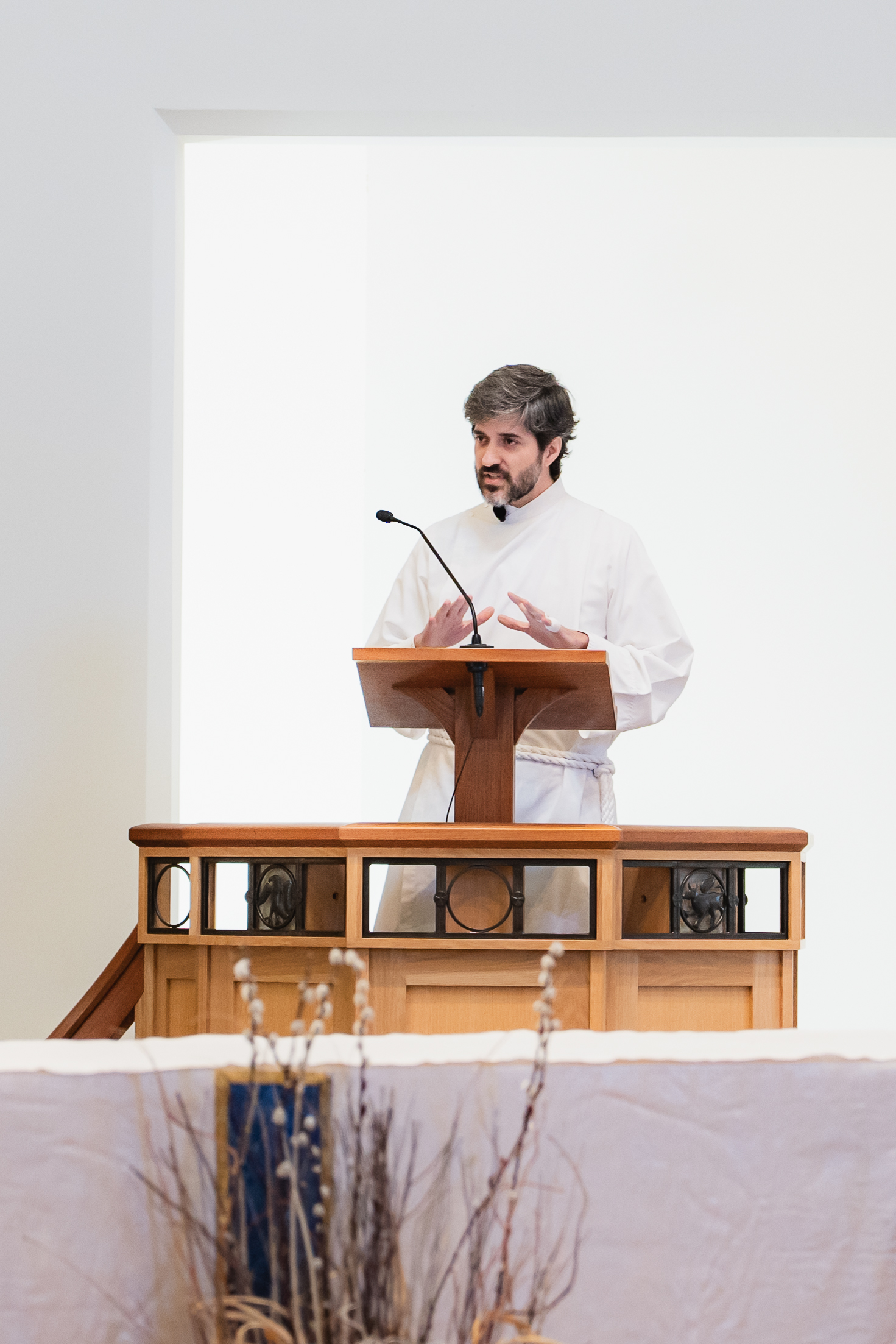
By Kyle B. T. Lambelet, Ph.D., Associate Professor of Ethics and Director of the Saint Nicholas Center for Faith and Justice

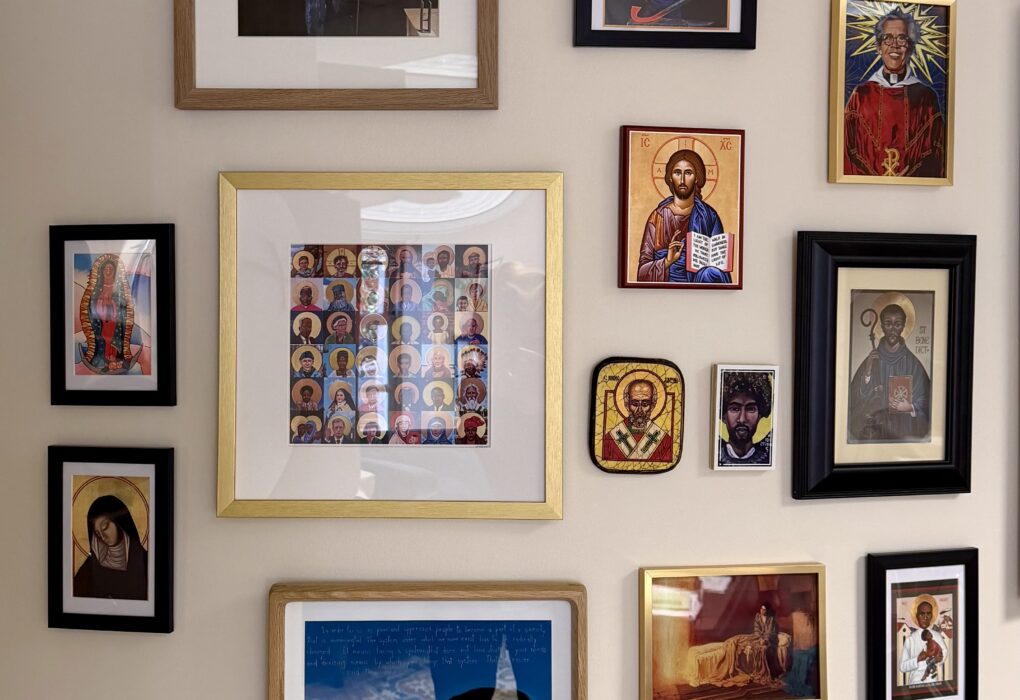
Since moving into my office in the basement of Bohlen Hall last August, I’ve been slowly assembling a collection of icons. The many boxes of books came first, of course. But after that, I’ve slowly gathered icons, images, and holy cards I’ve received over the years on a common wall. It bears more of a resemblance to my friend Antonio Alonso’s grandmother’s altarcito than an Orthodox iconostasis.

At the center of the wall is Christ the Teacher, an icon my mother gave me when I received my Ph.D. from Notre Dame. There is also Saint Benedict, depicted with raven and book, presumably his Rule, a gift from the director of my spiritual direction program. There is John the Baptist and Augustine of Hippo. And there are also a host of contemporary saints: Oscar Romero and the Jesuit Martyrs of El Salvador, Ella Baker, and Pauli Murray among others.

I first learned of this practice of displaying the images of exemplars and guides as an inspiration to holiness while living at a Catholic Worker community in Atlanta, Georgia in my twenties. In the old house, since demolished, in Poncey Highlands, we had images of Dorothy Day, Fanny Lou Hamer, Martin Luther King, Phil Berrigan, and Peter Maurin. As we took to the daily, mundane work of hospitality – cutting vegetables for soup, washing laundry for the clothes closet, brewing another pot of coffee to warm our unhoused friends – these images imbued each act with a sense of significance that outstripped their apparent triviality.

I’ve come to develop a fuller theology of the saints since my early adulthood, seeing them not only as Christians who model faithful discipleship in all its radical, contextual particularity, but also coming to pray with them as agents working in their way to inspire, shield, and strengthen us as followers of Jesus. Concerns of idolatry often accompany the use of icons, see the Seventh Ecumenical Council of 787 and the twenty-second of the Thirty-Nine Articles. But we can leave iconoclasm behind to appreciate the devotional significance of these images. They point beyond themselves to the living Word made flesh that incarnates in messy human lives. Looking through them, we can witness the weird agency of these holy dead.

The newest addition to this cloud of witnesses is an encaustic icon from Izmir, Turkey of Saint Nicholas. A gift from Carol Myers, this icon displays an elderly priest, bald with gray beard, wearing a white and green stole over a simple red chasuble. Encaustics use heated wax to create luminous images, and the wax of this particular icon cracked as it dried giving it a historic look, even though it was written in 2005.

Saint Nicholas, as Dean Markham likes to point out, is the world’s most recognized saint short of Mary and the Apostles. He is especially remembered for his generosity, thus the traditions of gift-giving that emerged in his wake. Less well known are his purported role in defending orthodoxy during the First Council of Nicaea, his successful appeals to imperial officials for forbearance and justice, and his confrontations with the cult of Artemis. More than the saint whose legacy produced Santa Claus, Nicholas the 4th Century Bishop of Myra was a witness of faith with justice in a time of significant cultural change.

Looking at and through the icons of these faithful witnesses, Nicholas among others, we catch a glimpse of the rich variety of vocations that God might be calling us to in our own time and culture. We too live in a time of significant cultural change. We too are troubled by questions of truth. We too are challenged by injustice. For me, these disciples and witnesses remind me not to grow weary in well-doing. This perseverance can call forth courageous public acts. But more often than not, for me at least, they strengthen my mettle for the humdrum work of teaching and writing: finishing a syllabus, drafting a lecture, meeting with a student. This mundane work is the stuff of formation. Through these daily habits we create a disciplined space to witness the Spirit’s ongoing work.

Kyle photo

Justice in the way of Jesus

Here at Virginia Theological Seminary, it is my happy privilege to serve as the inaugural director of the Saint Nicholas Center for Faith and Justice. Recently endowed with a gift from the David and Carol Myers Foundation, the center supports the formation of Christian leaders as faithful and effective advocates for justice in the way of Jesus. I may have buried the lead, but I share these musings on the communion of saints because I am convinced that it is these icons of discipleship that draw us into the work of faithful response to God’s call in our own time. To kick off a center is exciting public work, but it also entails mundane administrative toil, necessary and largely hidden from view. At the center of the work, though, is discernment of God’s call for us in this time, this place.

Launching the center over the past months, I have started where my own formation as an organizer, a scholar, and a spiritual director has taught me: first to listen. As Dietrich Bonhoeffer, another of the saints on my office wall, said in his perennially insightful Life Together, “the first service that one owes to others in the fellowship consists in listening to them.” What a gift it has been to listen. I’ve talked to dozens of faculty, students, alumni, and community partners, and I’ve been heartened by what I’ve heard. I’ve heard about the good work that has already been happening among students and faculty integrating faith and justice in our curriculum. I’ve heard stories about VTS’ Reparations Program and significant efforts at racial justice and healing. I’ve heard a hunger for spiritual formation that can support justice work for the long haul in seasons of political opportunity and seasons of political constraint.

Building on this prayerful listening, the Saint Nicholas Center for Faith and Justice is discerning, deliberating, and visioning what God might already be up to, and how we can support that work. We have hired three student fellows. We have hosted a faith and justice lunches with local organizers and faith leaders. We have rejoined Virginians Organized for Interfaith Community Engagement as a member organization. We have participated in the Virginia Interfaith Center for Public Policy’s Day for All People in Richmond.

And this is just the beginning. At the center of our work is the formation of Christian leaders for justice. This work will involve training in concrete skills of social and political engagement, pilgrimages to significant sites in historic struggles for justice, and new coursework that brings themes of faith and justice under shared reflection. It also requires spiritual formation for resilient vocations that can continue in times of change. The good news is that VTS has already been doing this work of formation. The Saint Nicholas Center for Faith and Justice builds on the strengths already existent in VTS’ curriculum and will introduce new opportunities for learning the skills and stories of faithful Christian witness.

Looking toward one small representation of the great cloud of witnesses on my office wall I’m reminded, as the author of Hebrews commends, to “lay aside every weight…and run with perseverance the race that is set before us.” (Hebrews 12:1)

It is by looking through these beautiful, broken lives to Jesus that we discern our own callings. I hope you’ll consider joining with us as we continue this work of shared discernment. How can we support your ministry of faith with justice? How can we work together to form Christian leaders that strive for justice and peace among all people? Where has God already been moving, and how can we celebrate and participate in that movement? What new work is the Spirit calling forth in this time and place?

Come visit me in the basement of Bohlen Hall and let’s listen together with the communion of saints.


:: Upcoming Event: Please join the Saint Nicholas Center for Faith and Justice at 6:30 pm on February 3, 2026, for the Mollegen Forum, when the Rt. Rev. Mariann E. Budde, Bishop of Washington, will give an address on The Politics of Mercy, with a response by the Rev. Sen. Kim Jackson, state senator of Georgia.

NEWS

ISTANBUL

VTS Pilgrimages

In 2026 VTS is offering three pilgrimages: Grace & Gardens in England’s “green and pleasant land,” May and September; and Biblical Turkey: Holy Land of the Early Church in October.

ALUMNI