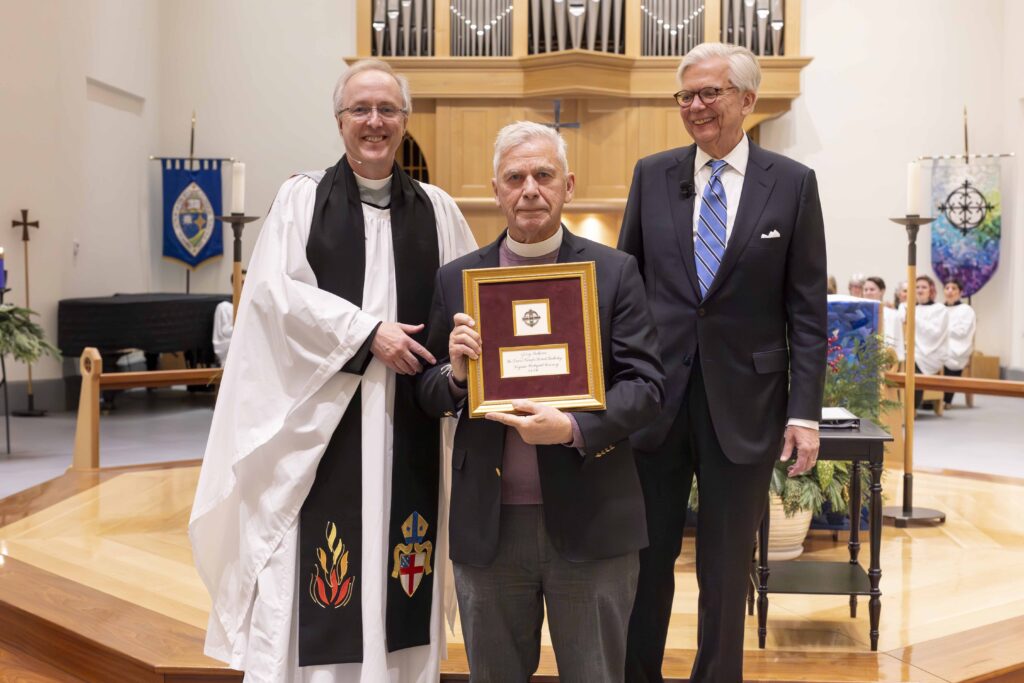
Virginia Theological Seminary has awarded the Rev. Canon Jerry Anderson the Dean’s Cross for Servant Leadership in the Church and the World – its highest honor. This accolade reflects not only his impact on the Church and society but also his enduring legacy as a beacon of hope and as a faithful servant of Christ. I was fortunate enough to sit down with Anderson and listen to his story as he participated in the VTS Archives’ Called and Holy: LGBTQIA+ Oral History Project. His life story is a profound testament to resilience, faith, and service.
Born in a small town in Southern Illinois to a Pentecostal preacher and coal miner, Anderson’s formative years were steeped in the challenges and joys of a close-knit community. These early experiences instilled in him a deep sense of compassion and a calling to serve others, a vocation that would define his life and ministry for five decades. After graduating from The General Theological Seminary, Anderson was ordained in 1968 at Saint Augustine’s Church in Wilmette, in the Diocese of Chicago. His journey as an Episcopal priest took him across the country, serving in diverse communities including Chicago, Washington, D.C., Miami, and Los Angeles. At each stop, he left an indelible mark, not only as a spiritual leader but also as a trailblazer in the fight for justice and inclusion.
In 1981, while serving as an associate priest at St. Patrick’s Episcopal Church in Washington, D.C., Anderson took a courageous step that would define much of his legacy. He publicly came out as a gay man, becoming the first priest in the Diocese of Washington to do so openly. At a time when acceptance within the Church was limited and societal stigma was pervasive, his bravery opened the door for critical conversations about inclusivity and the acceptance of LGBTQ+ individuals in The Episcopal Church. Anderson’s decision to live authentically was not without challenges. He faced discrimination and resistance, including being banned by VTS from supervising seminarians completing their field placements. This was due to systemic discrimination practiced by the Seminary, which counted field supervisors as adjunct faculty. Homosexuals were restricted from serving as faculty at VTS, according to official policy.
As the AIDS epidemic began to devastate communities in the early 1980s, Anderson’s ministry took on a new and urgent dimension. In 1986, working with Bishop John T. Walker, he co-founded The Episcopal Caring Response to AIDS in the Diocese of Washington. This organization provided critical support to individuals and families affected by the crisis, offering not only material assistance but also spiritual care and advocacy at a time when fear and misinformation surrounded the disease. A decade later, in 1996, Rev. Anderson replicated this compassionate work in Miami, where he founded The Episcopal AIDS Ministry at Trinity Cathedral. His efforts were instrumental in creating safe spaces for those living with AIDS, breaking down stigmas, and ensuring they received the dignity and care they deserved. Through his ministry, he embodied the Church’s call to serve “the least of these,” reaching out to those who were often abandoned or ignored.
Beyond direct ministry, Anderson became a tireless advocate for people living with AIDS, using his voice to influence policy and perceptions within The Episcopal Church and beyond. He spoke passionately at The Episcopal Church’s General Convention and on national and international platforms, urging the Church to embrace its role as a sanctuary for all people, particularly those marginalized by society. His advocacy contributed to The Episcopal Church’s journey toward becoming a more welcoming and affirming institution. Anderson’s work helped to dismantle barriers of exclusion and fostered a greater understanding of the Church’s responsibility to uphold the dignity of every human being.
His life stands as a powerful testament to his faith and dedication to serving those afflicted by AIDS, providing a source of inspiration and hope for others. Anderson’s reflections on his journey and ministry are captured in his memoir, Ordained by Angels: A Memoir of an AIDS Chaplain. The book chronicles his life, the struggles he faced, and the love that sustained him.
It pleased me to see VTS recognize the immense contributions of Anderson and the profound challenges he faced, including discrimination and homophobia, some of which stemmed from within the institution itself. As the Seminary seeks to confront its own history, it acknowledges these injustices and humbly asks for forgiveness. This repentance is a model that needs to be adopted by the wider church as it seeks to be Christ in the world.
Though once banned by the institution, VTS now celebrates Anderson’s extraordinary ministry and his unwavering dedication to serving Christ through acts of love, compassion, and justice. Anderson’s life is a testament to the transformative power of love, compassion, and grace. His work with people living with AIDS, his advocacy for LGBTQ+ inclusion, and his faithful service to countless communities exemplify the very essence of servant leadership.